When Elena Rybakina won her 2026 semifinal to set up an Australian Open final rematch with Aryna Sabalenka, it created major ripples.
Firstly, it was the resumption of a compelling rivalry, where a deciding set had been required in nine of their 14 meetings, and one Sabalenka narrowly led 8-6.
Secondly, it evoked memories of their previous AO final, a high-quality three-set classic in 2023 which Sabalenka won to claim her first Grand Slam title.
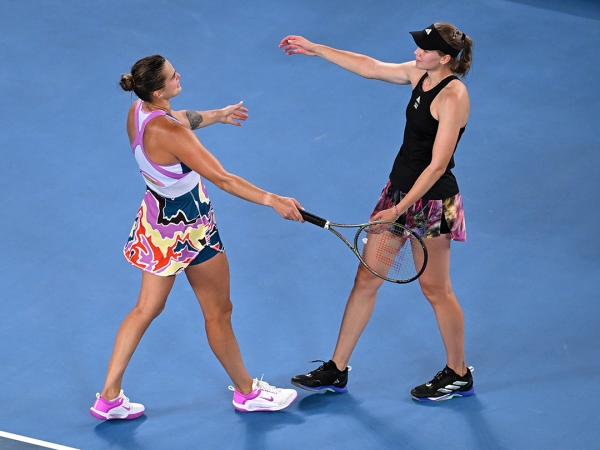
And thirdly, it meant Rybakina and Sabalenka became just the sixth duo in the professional era to lock in an Australian Open women’s singles final rematch.
In doing so, the pair joined some iconic names in women’s tennis, champions of the sport we’re celebrating on International Women’s Day.
Going chronologically, we begin with a pair of Aussie greats.
1973 – Margaret Court v Evonne Goolagong
When the dominant Court played Goolagong in the AO 1971 final, she’d won nine of the past 11 editions of the tournament. Yet Goolagong almost pipped her, ultimately losing 2-6 7-6(0) 7-5 at White City in Sydney.
When the two countrywomen met again two years later – this time at Melbourne’s Kooyong Stadium – Goolagong was appearing in her third straight AO final, seeking her first title.
Again, Court prevailed, in another tight battle (6-4 7-5) for her 11th and final AO title.
It represented the end of one era and the beginning of the next; Court would play just one more AO while Goolagong swept four of the next five titles – including three straight from 1974 to 1976.
1982 & 1985 – Martina Navratilova v Chris Evert
The greatest rivalry in the history of women’s tennis is also the only AO women’s singles final match-up to occur more than twice.
Navratilova survived Evert 6-7(4) 6-4 7-5 in their first AO final of 1981, and their rematches in 1982 and 1985 were similarly riveting.
Evert avenged her loss to Navratilova in the 1982 final – winning 6-3 2-6 6-3 to complete her career Grand Slam – before Navratilova beat Evert again in 1985, this time 6-2 4-6 6-2.
As well as sharing all five AO titles from 1981 to 1985, Navratilova and Evert reached the finals, respectively, in 1987 and 1988 – meaning at least one of them appeared in an AO final for seven straight editions of the event.
2002 – Jennifer Capriati v Martina Hingis
Capriati’s straightforward win over Hingis in the 2001 final – she won her first major title in just 63 minutes – was the opposite of what unfolded in their AO final rematch just 12 months later.
In oppressive heat, Hingis surged to a 6-4 4-0 lead and held four championship points before Capriati staged one of the sport’s all-time great comebacks.
“The conditions, I had never experienced anything like that, that kind of heat. I thought to myself, ‘oh man, this is going to be tough’. It was like another opponent out there,” Capriati reflected in a recent episode of The Sit-Down podcast.
“There were so many momentum shifts… I just said ‘this is an endurance game. Just hang in there and tough it out as best as you can’.”
Her eventual 4-6 7-6(7) 6-2 win marked Capriati’s third major title in the span of just five Grand Slam tournaments.
She is one of just nine women in the Open era to defend an AO title.
2015 – Serena Williams v Maria Sharapova
Eight years had elapsed since Williams pummelled Sharapova for the loss of only three games in the 2007 final, completing a phoenix-like run to the title.
When they met again in the AO 2015 final, this time as the world’s top two players, it was far more evenly matched.
Despite Williams winning again, this time 6-3 7-6(5), the first set alone took 47 minutes and the second saw Sharapova save two match points before Williams struck a final ace to complete victory in just under two hours.
This match is one of 10 Australian Open women’s finals to be contested between the world No.1 and No.2, and the second-most recent.
2017 – Venus Williams v Serena Williams
After first clashing in the AO 2003 final, sisters Venus and Serena Williams faced off again in the final 14 years later – by far the longest span between first and second AO final meetings in the Open era, among men or women.
Serena triumphed in three sets in 2003 to complete her famed ‘Serena Slam’ – winning four majors in a row, but not in calendar order – and did so again in 2017 to win her 23rd and final Grand Slam title.
Serena’s victory, at age 35 years and 124 days in 2017, makes her the oldest AO women’s singles champion of all time, and the oldest women’s singles champion at any of the four Grand Slams in the Open era.
2026 – Elena Rybakina v Aryna Sabalenka
When Sabalenka won their AO 2023 final for her first major, it came just six months after Rybakina had hoisted her first Slam trophy at 2022 Wimbledon. Sabalenka’s eventual 4-6 6-3 6-4 win was a fittingly close battle between two of the game’s brightest stars.
Grand Slam final rematches have become increasingly rare in women’s tennis, yet when the duo met again three years later at AO 2026, it was another three-set barnstormer.
This time, however, Rybakina flipped the result by a near-identical scoreline. From 3-0 down in the third, she closed out a 6-4 4-6 6-4 win with an ace to capture her second major title.
This was their fifth meeting in a tournament final, and Rybakina has won the last four.