Beyond standout results, match analyses, points races and players’ social media activity, some stories in tennis tend to catch us a little more by surprise.
It’s why at ausopen.com we’re launching our ‘Serving Up Surprises’ series. We figure if the revelations pique our interest, our readers will find them fascinating too.
This time we begin with a former Australian Open champion…
Crystals power Clijsters to AO 2011 title
Former world No.1 Kim Clijsters launched the Love All podcast with co-host Blair Henley in early 2026. On a recent episode, she revealed she competed at Australian Open 2011 with crystals pinned under her skirt.
“A weird thing, I won the Australian Open with like two crystals, different type of crystals, like healing crystals, under my skirt, on my skin,” she laughed. “Really little ones, like in a little mesh bag, and they were [secured] with a safety pin, on my right side of my leg.
“Whether it helped, anything at all, but in my head at the time I did believe in it, energetically.”
AO 2011 was the fourth and final major title of Clijsters’ career, coming amid one of the best stretches of her career. It marked back-to-back Slams after she’d won the US Open four months earlier and in February 2011 she returned to world No.1, almost five years since she’d last been at the summit.
You can check out the full conversation about Clijsters’ crystals in the 22 July episode.
Artificial grass at Wimbledon
Did you know there are two part-artificial grass courts at Wimbledon’s Aorangi Park practice facility?
Three-time Wimbledon finalist Andy Roddick certainly seemed surprised, judging by his facial expression when Tim Henman joined him for a Q&A episode on Roddick’s podcast, Served, before the 2026 Championships.
“There’s a company called the STRI, Sports Turf Research Institute, and on the back of your American football pitches, but our soccer and rugby pitches, a lot of them now are part-artificial,” explained Henman, a four-time Wimbledon semifinalist and now All England Club board member.
“They have five per cent artificial grass and then when you sow the natural grass, the grass binds around the artificial element and makes it a lot stronger.
“We put in two [of these practice courts] at Aorangi and didn’t really say anything; they’ve been there for four or five years and the players play on them and they play really identically, but they’re a bit harder-wearing.”
This forms part of the work Henman explained is going into the grasscourt tennis space, including their sustainability and how they can be played on for longer periods of the year.
Green clay is a carbon sink
Speaking of tennis surfaces, green clay is being celebrated for properties that could combat climate change.
As revealed in a recent Racquet magazine feature, “though the terre battue of Roland Garros represents the standard when it comes to clay, a court of a different colour could offer a surprising response to the climate challenge facing tennis… They’re often dismissed as somehow sub-par, but green clay courts save the carbon emissions equivalent to taking 4200 cars off the road every year.”
The feature spotlighted a study, published in the Applied Geochemistry journal in March 2026, demonstrating the material comprising green clay courts – meta basalt rock, sourced from the Blue Ridge Mountains in Virginia – can sequester CO₂ emissions.
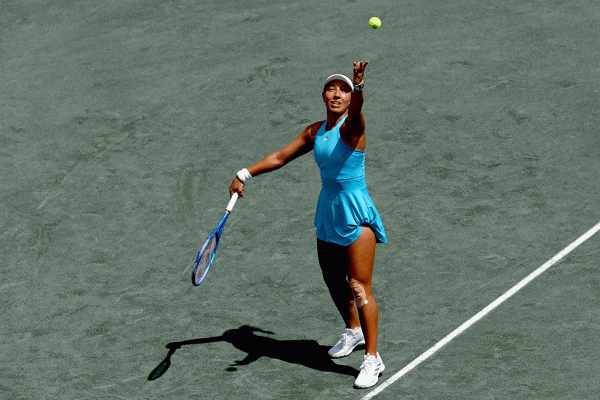
Green clay is niche in professional tennis, with just one tour-level event – the long-running WTA 500 tournament in Charleston – staged on the surface, plus a handful of Challenger-level tournaments.
Green clay courts are found primarily in the southeastern United States.
You can read the full Racquet feature here and if you feel like diving into the science underpinning it all, check out the research paper.