Tennis is the one of the most watched professional sports globally, and one of the reasons for that is its many points of difference.
In a month where players have shifted between grass, clay and hard courts, we examine 10 ways in which tennis is unique.
1. Different surfaces
A quick way to tell where a tournament is being held is by looking at the court colour and surface.
Tennis is one of the rare sports that is contested on different playing surfaces. The Grand Slams alone are held on three different surfaces, with the Australian Open and US Open being hardcourt events, Roland Garros played on clay and Wimbledon on grass.
The type of balls used can also vary by surface and create unique conditions, as can a tournament's outdoor or indoor status.
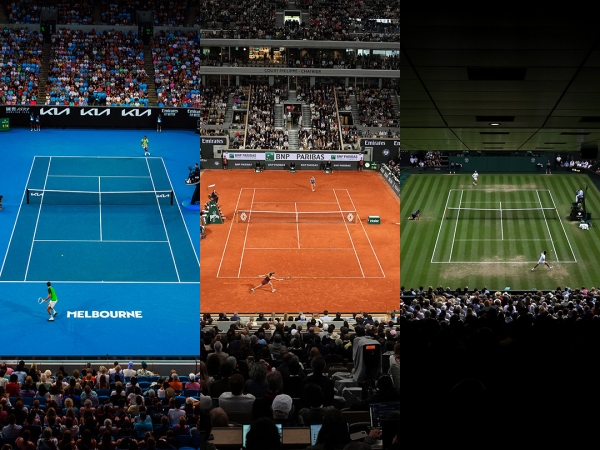
Few athletes are forced to adapt to as many different variables in their competitive careers.
2. Scoring system
Although filled with lots of love, tennis has perhaps the least straight-forward scoring system.
It is believed this method dates back to medieval France – ‘deuce’ comes from the phrase à deux de jeu, meaning two [points] for the game – while some suggest it came from using clocks to keep track of the score.
RELATED: A guide to scoring in tennis
Until the emergence of padel, tennis was the only sport that followed this unique way of scorekeeping.
3. No clock
Unlike most sports that have a fixed game duration, it’s almost impossible to predict when a tennis match will end and when the next one will begin.
There have been many instances when it appeared a session was about to conclude, only for it to extend far longer – when Jennifer Capriati looked on the brink of a quick straight-sets loss to Martina Hingis in the AO 2002 final, only to climb back from 4-6 0-4 down and win an epic three-setter well over two hours.
Some matches have even extended into the early hours of morning – when Lleyton Hewitt beat Marcos Baghdatis in the third round of Australian Open 2008, the match set the record for the latest-finish at a Grand Slam, concluding at 4:34am.
The AO 2023 skirmish between Andy Murray and Thanasi Kokkinakis was not far off, ending at 4:05am.
4. Technical + tactical + physical + mental
It could be argued that tennis is the one of the most demanding sports that pushes the athletes to their physical and emotional limits as they're trying to achieve technical perfection. Without teammates on the sidelines, no substitutions and no clear finish line, they require a certain quality that is distinct to other sports.
"Tennis is not just about hitting the ball. It is about more than that. It is about mentality, physical side," Carlos Alcaraz explained in 2025.
Added renowned coach Patrick Mouratoglou: “Technically, it’s incredibly demanding. For many beginners, it can take months – even a year – before they consistently strike the ball well. It’s a sport that demands patience and precision.
"Mentally, it may be one of the most challenging environments in sport. The frustration can be intense. You’re alone on court, managing pressure, mistakes, momentum swings, and emotions in real time. There’s nowhere to hide.
"Physically, it requires everything: explosiveness in your first steps, speed, endurance, vertical power, lower and upper body strength, and elite cardio.
"And tactically, the layers are endless. Every point is a problem to solve."
5. Elevation of women
Tennis is a trailblazer for women's professional sport, becoming the first major sport where women could feasibly make a living thanks to the efforts of the Original 9 – led by Billie Jean King – in the early 1970s.
“First, we wanted any girl born in the world, if she was good enough, to have a place to compete. Second, we wanted women to be recognised for their accomplishments, not only their looks. And finally, and the most important thing, we wanted for ourselves and future generations to be able to make a living playing professional tennis," King recalled.

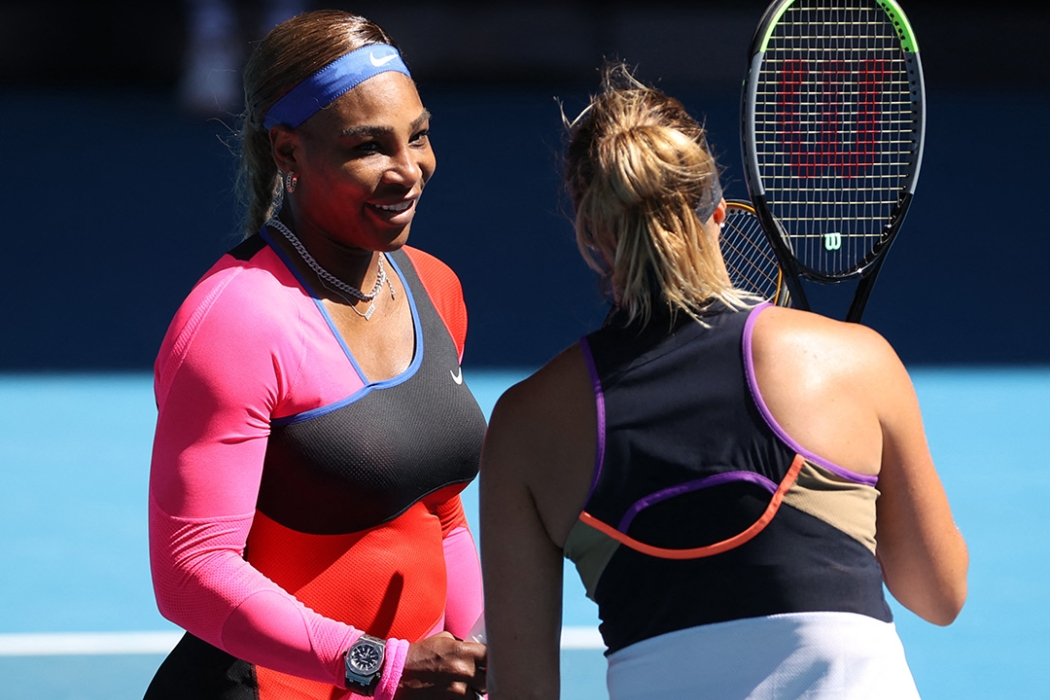
Former world No.1 King also fought for equal pay at the Grand Slams, which is delivered by all four majors today.
Woman and men share the same stage (or rather, Cente Court) at several of the sport's biggest events every year, creating a visibility and platform for female players unrivalled among women’s sports.
It’s clear tennis can be the most lucrative sporting pathway for women, highlighted by Forbes’ annual ‘World’s Highest-Paid Females' list. Coco Gauff clinched top spot in 2025 and was followed by Aryna Sabalenka and Iga Swiatek. Tennis players made up eight of the top 10 earners.
6. It's truly global
From the shores of Mallorca to the concrete jungle of New York City, tennis players' passports get a good workout.
The season takes them to all corners of the world; the 2026 ATP Tour consists of tournaments across 29 countries, while this year’s WTA Tour visits 26 countries, allowing athletes to travel globally while living out their tennis dreams.
On average, they can visit anywhere between 10 to 30 countries every year, making them the ultimate jetsetters.
7. The coaching journey
While it’s common to see a coach shouting from the sidelines or bringing a team in for time-out in other sports, tennis hasn’t always embraced coaching during matches.
The Australian Open only introduced limited on-court coaching in 2023, allowing coaches that are seated on the same side as their player to speak or use hand signals to communicate with them. World Tennis (formerly the ITF) also changed their guidelines to allow off-court coaching in 2025 – offering a new approach to the game.
8. Variety of formats
Players can compete in singles and doubles on tour as well as in mixed formats, with women and men having the opportunity to play together at Grand Slams, the Olympics and the United Cup.
Some players enter all three formats in a single tournament and there have even been occasions where they’ve won each of those event categories at a Grand Slam tournament, known as achieving the ‘Triple Crown’ – something King, Margaret Court and Martina Navratilova have achieved in the Open era.
9. A year-round sport
A calendar season in tennis is the longest in any major sport, meaning fans can watch their favourites battling it out at pretty much any point in the year.
Compared to other sports such as Australian Rules football, a professional season which runs for seven months, and the National Basketball Association season that operates for eight months, tennis spans 11 months each year, beginning in January with the Summer of Tennis in Australia and concluding with the Davis Cup Finals in late November.
10. A sport for life
Even after an elite player hangs up their racquet, many of them remain connected to the sport well beyond the competitive days.
And studies have shown that playing tennis can increase life expectancy by almost 10 years on average, longer than other sports that were tracked.
Another reminder that it’s never too late to get started!