This article first appeared in the August/September 2026 issue of Australian Tennis Magazine. To order your copy, visit tennismag.com.au.
For all she has achieved, and all that may still lie in front of her, Naomi Osaka has found her happiest place by living firmly in the moment.
“I think about how time is always ticking,” Osaka smiled earlier this year at the Australian Open, with her three-year-old daughter Shai clearly in mind. “Even when I talk to my daughter now, she likes to watch my practices, which is something new, on FaceTime. “It’s so cute because I can hear her say, ‘Go Mommy, go’, on the sidelines.”
As one of the most intriguing personalities to light up the tennis world in recent decades, Shai is not the only one cheering Osaka, now 28, along. After her Grand Slam breakthrough at the 2018 US Open, the Japanese-born Osaka went on to add three more majors (Australian Open triumphs in 2019 and 2021, along with another US Open title in 2020) and make history as the first Asian player to rise to world No.1.
With those accomplishments came astonishing stardom, Osaka regularly featuring on ‘highest paid’ and ‘most influential’ lists for the likes of Forbes and Time magazines.
At the Tokyo Olympics in 2021, she became the first tennis player to light the Olympic flame at the opening ceremony.
But it’s balance, apparently, that’s more recently helped Osaka strike a winning formula, as she demonstrated during the most successful clay and grasscourt seasons of her career.
After a maiden appearance in the second week of Roland Garros, Osaka performed even better at Wimbledon, where she stunned world No.1 Aryna Sabalenka to reach the quarterfinals for the first time. It followed a maiden final on grass in Bad Homburg, where a niggling foot injury forced her to withdraw from the final against Karolina Muchova.
Those career-defining breakthroughs on natural surfaces were helped by the hard work undertaken with coach Tomasz Wiktorowski, who had previously guided former world No.1 Iga Swiatek and 2012 Wimbledon finalist Agnieszka Radwanska.
“He brings a lot of belief. I would say he gives me a lot of structure,” Osaka said of the confidence and clarity that Wiktorowski has helped instil since joining her team in mid-2025. “I appreciate that, because it’s not like during the match I’m confused on what I’m doing.”
There were also targeted strategies to boost Osaka’s grasscourt prospects – most notably at Wimbledon, where she had never advanced beyond the third round before this year. “I just always in my head considered myself a hardcourt player,” the 14th seeded Osaka conceded.
Circumstances were partly a factor, with a lack of grass courts at Osaka’s training base. But under Wiktorowski’s direction, movement became a focus. “He challenges me a lot to think outside the box … we were just doing a lot of different things,” she said, explaining how some “really weird drills” developed her perception of speed and depth of the ball.
“It’s kind of made me understand grasscourt tennis a lot more. I think when I was younger, I was a little bit more stubborn on how I wanted to play on this surface, but I realise it’s a lot more free-flowing.”
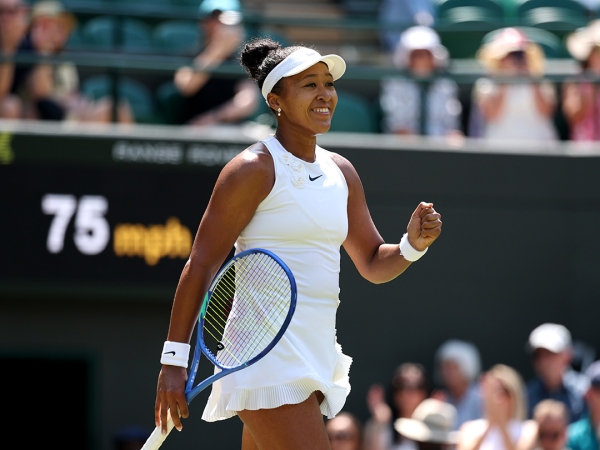
Those improvements helped Osaka improve on her natural weapons, including the serve – which as she explained at Wimbledon, she developed almost by accident when she was practising with sister Mari at age 15.
“I remember my knees always used to hurt because I kept growing,” she said. “Then one day I decided to hit my serve as hard as I could. It went in. It was an ace. I thought ‘If I can just keep doing this, keep going for it, it would be a really solid addition to my game’.”
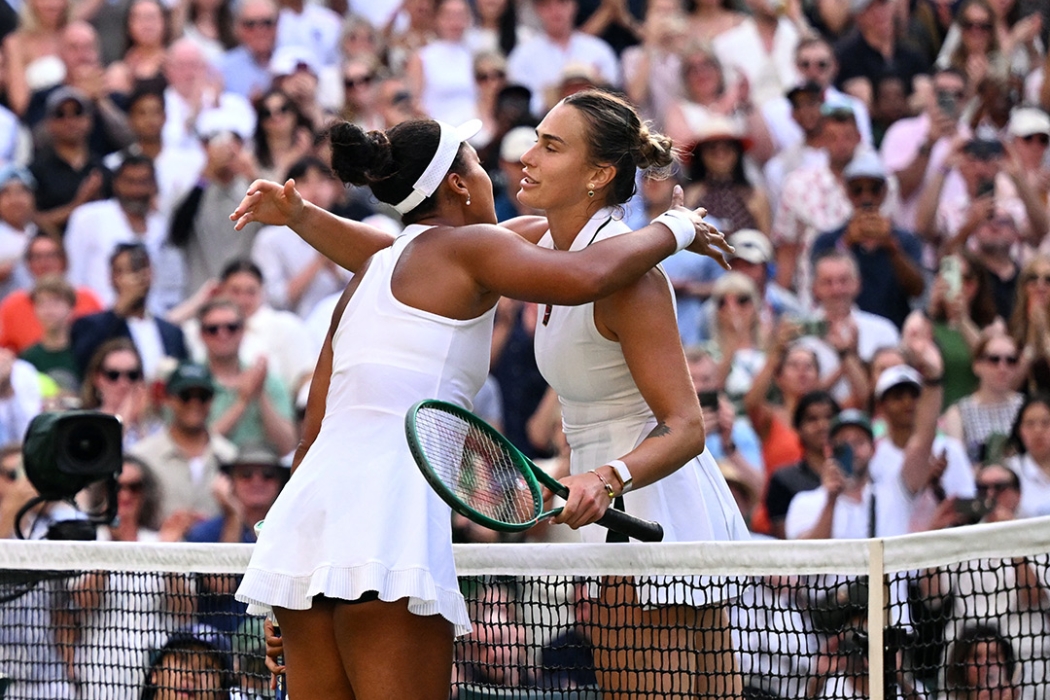
Osaka’s power was never more evident than in her victory over Sabalenka at Wimbledon. Her 6-2 7-6(2) triumph came after three earlier losses to the world No.1 this year.
Sabalenka’s stark assessment that “she overpowered me” underlined how superbly Osaka had harnessed that power, with a clear tactical plan underpinning her statement win.
“Obviously we’re big ball strikers … it’s not like I’m going to start running around the court trying to draw an error from her,” Osaka said. “I can only focus on my strengths. I just tried to serve really well [and] to get the upper hand in the rallies first.”
The other statement for Osaka at Wimbledon was of course the fashion kind. Following her dramatic entrances at the Australian Open and Roland Garros, Osaka’s unique look honoured her Japanese heritage at Wimbledon.
“Obviously I really love fashion. That makes me excited to wake up and do the whole, like, walk-on or whatever. It just creates a little bit more joy in that whole match preparation,” she related of the signature looks that have become a talking point of the tennis world.
“But I grew up with the G.O.A.T.s of style, Serena [Williams], Venus [Williams], [Maria] Sharapova. People don’t talk about her enough, but Bethanie Mattek-Sands, too. She made it work with what she had.”
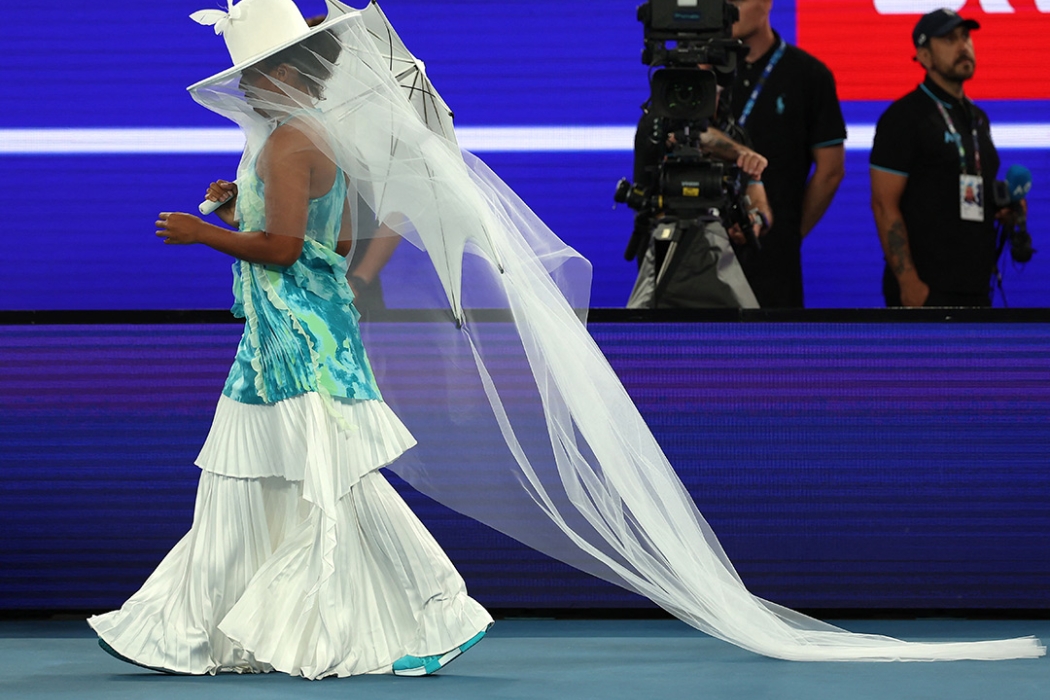
While the attention-grabbing looks can seem at odds with Osaka’s sometimes introverted nature, they also add to an intriguing on-court persona. “I feel like when I step on the court, I’m not the me that you’re talking to right now. I would never yell ‘C’mon’ that loud in, like, a normal setting,” she smiled.
“I almost feel like I’m a Barbie that dresses up and goes on the court and does something. When I come back in the locker room is when I’m like my true quiet Naomi.”
AO on SUBSTACK: Osaka leads unofficial Paris Fashion Week at Roland Garros
The love for fashion – and Osaka’s undeniable celebrity – are also evident in her appearances at New York’s famous Met Gala. On her return to the event for the first time in five years this year, Osaka wore a custom two-piece outfit that had reportedly required more than 3200 hours of handiwork by couturier Robert Wun.
It’s activities like these, Osaka noted, that help balance the intensity of life on tour. “I know some people might not think that way. They say you shouldn’t distract yourself. For me I think it’s important to have a life outside of tennis. Especially now I have my
daughter,” she said.
“I just want to try new things and experience things and eventually build something for her that she can inherit one day.”
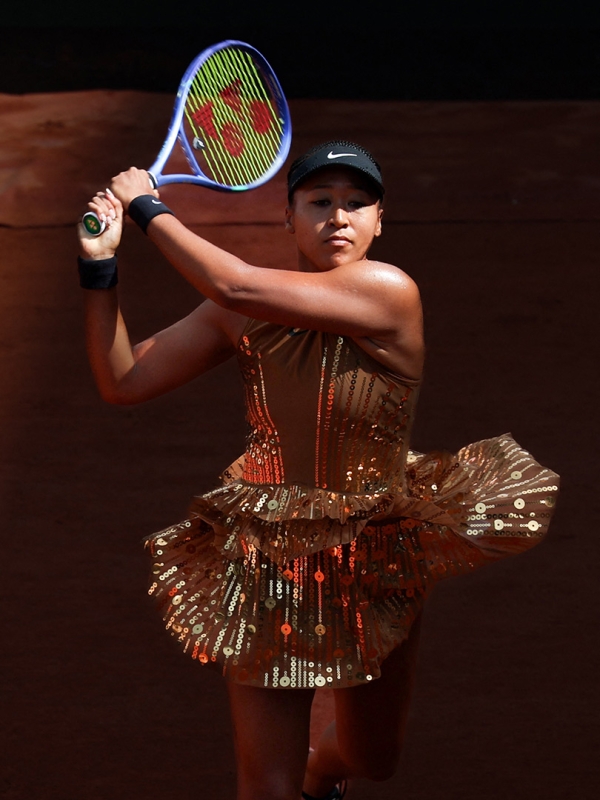
And as she returns to the North American tournaments that have delivered some of her most career-defining victories, Osaka is also setting a positive example to her daughter – and many fans – in other ways.
Far from discouraged by her eventual loss to Muchova in the Wimbledon quarterfinals, a grateful Osaka instead offered refreshing perspective.
“I feel as long as I wake up every day and hit the ball and think I’m improving, that itself is a win. I think I reached an enlightenment, but in a healthy way for me,” she said. “Because obviously I pour so much into tennis. Like, if I lost this match when I was younger, I’d shut myself in my room or whatever. But now I feel like obviously I love tennis, and I’m trying my best to do everything to be the best player I can.”
And while going home to Shai provides “the happiest moments of life for me”, Osaka is finding similar joy on a tennis court.
“I’m a little bit of a perfectionist, only when it comes to tennis, though, because I have been playing since I was so young, and I want things to go a certain way,” she added.
“But I’m learning how to let go and kind of just take every day as a new adventure.”