Deep below Rod Laver Arena is a place where magic happens.
Through the subterranean tunnels, where the sound of the crowds and the heat of high summer feel far away, if you follow the smell of polish and ink, and the sounds of clicking and whirring, you’ll find yourself in the Yonex stringers room.
MORE: All the scores from AO 2026
The first thing to notice is the flurry of motion. Behind every Precision 9.0 machine is a dedicated stringer – a professional technician responsible for stringing tennis racquets – who expertly threads polyester and natural gut (cow intestine) to the perfect tension, as specified by the owner of the particular racquet.
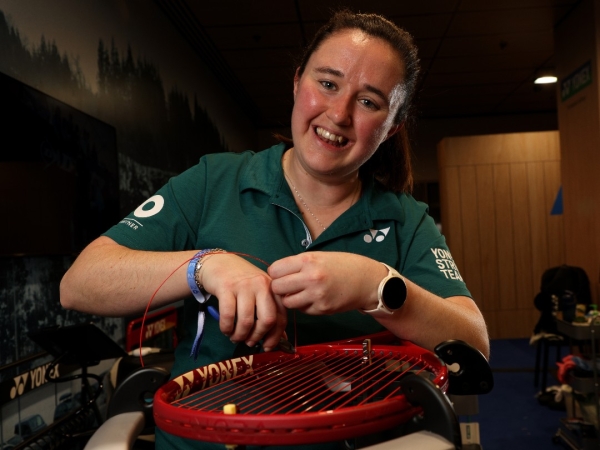
Sarah Bloomfield, or ‘Bloomers’ as she’s fondly referred to by her team, is positioned at the furthest machine from the entrance, concentration etched across her face as she feeds the natural gut through the clamp and sets the tension.
The Australian Open is one of the busiest times for a stringer, but Bloomfield is the picture of poised control.

That’s because this isn’t her first rodeo, so to speak. Bloomfield is a cornerstone of the Yonex stringing team and over the course of 14 years has worked at six Wimbledon tournaments as well as the Olympic Games in Paris in 2024. This is her second time in the stringers' room at the Australian Open. Even before that, tennis has always held a special place in her heart.
“I was a tennis player as a junior,” Bloomfield said. “I used to play tennis a lot. And then in between lessons I'd go into my local clubhouse and my boss would be stringing and I just found it fascinating watching her.
“And then when I was around 16, she was like, do you wanna learn to string? So, she taught me and the rest is history. Now I'm here.”
‘Here’ is a strangely calming space, beyond the general hubbub of activity. The tick, click, whir of the strings feeding through the machine and weaving across the racquet face is somewhat of a tennis lullaby, akin to the rhythmic pop of a tennis ball as it’s thwacked by a racquet on court.
When asked what she finds so fascinating about the stringing process, Bloomfield says, “It's very hands-on and manual. Although we do it on a machine, it's still a very manual process and just seems kind of therapeutic.”
For a player, the way their racquet is strung is critical to their performance and extremely specific to their style of play. Consequently, no two stringing jobs are alike. But there are still those jobs that stand out against the rest.
“When you have a very low tension or a very high tension, they always kind of pique the interest of the stringers in the room,” Bloomfield said.
“I've had one player that's asked for a logo to be the opposite way round on the strings to how we would normally do it, and that's because they can feel the weight of the ink and it makes their racket unbalanced … I think that's more psychological than actually a thing. But [we] had to do it the other way round.”
It’s a testament to the commitment that Bloomfield and the Yonex team have towards their craft that they can accommodate these requests during peak tournament times when demand is at its highest.
“The first day of quallies and then the day before the first day [of main draw] is always a hectic kind of night,” Bloomfield said. “Everyone's getting prepared for the tournament. We usually get in around 7am, 8am. You'll have a set of morning rackets, probably six or eight. And they need to be done before the first practice. You'll then get another couple last minute to do for the first matches.
“There’s a little bit of downtime when the matches start at 10am. You probably have time to have coffee or some breakfast. And then throughout the day it's just a bit more consistent … On average you do, I'd say 30 to 40 rackets a day. We leave half an hour after the last match finishes.
“So, when you think about it, it's a very long day. Very long day.”
Despite the time commitment, what keeps Bloomfield coming back are the people. The Yonex stringing team are a close-knit bunch, the high pressure of a tournament bringing together a team of people who can unite over their shared passion.
“Because we spend so many hours together, you just get absorbed by the atmosphere. You are all helping each other out. You're cheering each other on and there's always fun little rivalries within the stringing team.”
Blomfield gestures to the machine behind her with a smile, “Me and Justin here had both our players playing against each other just now, so we are watching the match cheering on our own players ... those little rivalries are really fun to reconnect with the people that you get on with so well.”
“You become like a little family,” she says.