As Novak Djokovic has built a playing career widely lauded as the greatest of all time, there are multiple reasons given for why he has been so successful.
His mental toughness. His technical proficiency. His movement and flexibility. His training methods, and ability to remain relatively injury-free throughout a 20-year career. His motivation and focus. And the list goes on…
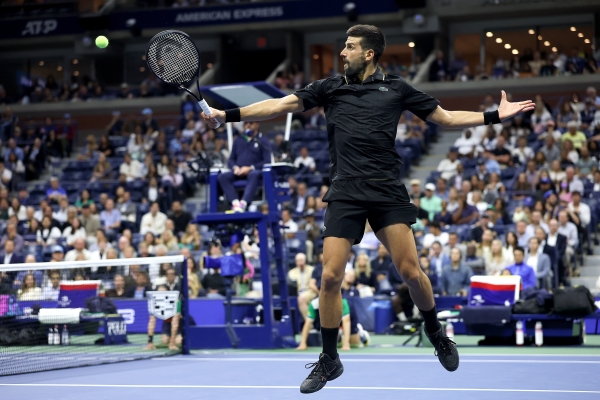
Yet a relatively underdiscussed weapon in his arsenal is his ability to change direction with his backhand.
Djokovic hits his backhand down the line more than any other top ATP player. He’s committed to that shot even more in 2026 as a proportion of overall backhands, which considers those hit crosscourt versus down the line. In the past three seasons he’s hit more than 30 per cent of his backhands down the line – a number approaching almost 36 per cent this year.
Season 2026 might not have been the best of his career, yet at 39 years of age he recently won the ATP 500 title in Beijing, beating Alexander Zverev – a two-time major winner this year and soon-to-be-world-No.1 – along the way. He also outplayed Jannik Sinner in the Australian Open semifinals in a masterful five-set display to reach his 38th career Grand Slam final.
“His backhand down the line is a signature redirect shot,” said Simon Rea, former coach of Sam Stosur and Nick Kyrgios and now Head of Game Analysis at Tennis Australia.
“I think we're [more broadly] seeing the emergence of a quality backhand down the line as being a weapon all of itself. And we've seen that probably in women's tennis, before we've seen that in men's tennis.
“[In men’s tennis] the forehand is becoming a bigger weapon, and players are becoming more proactive and assertive to want to find their forehand. They're moving the centre of the court, metaphorically, further to the left as a right-hander. So it becomes harder to get the ball into their backhand wing.
“The counter to that, when you're pinned in your backhand corner and someone is dominating you with their inside-out forehand, is to take the backhand down the line, even on a neutral ball or potentially on a defensive ball.
“If you can do that well, that’s a great antidote to playing someone who is forehand dominant.”
Djokovic can exploit these rally dynamics perhaps better than anyone. And at the same time, there’s another pattern working in his favour. Given so many ATP players hit a higher percentage of their backhands crosscourt, they’re typically sending them straight into Djokovic’s dangerous backhand corner.
Taylor Fritz, for example, hit only 18 per cent of his backhands down the line in 2025.
Previewing his US Open quarterfinal against Djokovic that year, Nick Nemeroff identified Fritz’s predictable backhand direction as a factor in his 0-10 record against Djokovic, who had won 23 of their 26 sets.
“Can’t just rally crosscourt with the best backhand ever,” he wrote on his @Big3Tennis X account. “Fritz has become so strong at what he does but ultimately it’s not enough variety to beat the best of all time. In order for him to win this match, he’ll need to change direction with his backhand, shorten up points, and move forward a lot.”
Fritz’s backhand-down-the-line figure fell to just 10 per cent as Djokovic went on to win in four, setting up a semifinal against Carlos Alcaraz who, like Djokovic, plays creatively from his backhand wing.
Of the top five ATP players at the time, Djokovic and Alcaraz most often went down the line with their backhands, at 31 and 28 per cent respectively. Like Djokovic, Alcaraz has in 2026 increased his proportion of down-the-line backhands, to more than 30 per cent.
Both employ backhand variety in other ways, too. In 2025, Djokovic and Alcaraz sliced more than 20 per cent of their backhands, the highest proportion among the then-top five. It’s a percentage Alcaraz has maintained in 2026, a season during which he won the Australian Open and has built a 33-5 record.
In New York last year, Alcaraz ultimately beat Djokovic to set up a US Open final against Sinner, another player intent on incorporating more backhand variety.
The Athletic, having interviewed Sinner’s coach Darren Cahill, reported in August 2025: “Sinner used to almost always hit his backhand crosscourt. Opponents knew what was coming. During the past year, [Cahill] said, Sinner’s ability to pull the trigger on a backhand down the line has been a complete game-changer.”
While Alcaraz won their US Open final, Sinner then went on a tear, closing 2025 with titles in Beijing, Vienna, the Paris Masters and ATP Finals. In Turin, his backhand down the line was especially devastating.
Hot Shot: 'Brilliant' Sinner surprises Alcaraz with special strike at Nitto ATP Finals 2025! | ATP Tour | Tennis
“Year on year, we're seeing Sinner go down the line, not a huge amount more, but incrementally more when comparing 2024 to 2025 to 2026. Our data supports that,” Rea explained.
“We're also seeing him incorporate the drop shot more in 2026 than he has before. So he's prepared to add layers to his game on the backhand side. We’ve also seen an increase in ball speed from him, year on year, on the backhand side.”
As Rea noted, the down-the-line backhand is a more prevalent shot on the WTA Tour. And this has been the case for years.
"When I was younger, I learned to try to be the first one [in the rally] to change directions,” former world No.1 and four-time major champion Kim Clijsters revealed on the Love All podcast.
“But you have to feel comfortable with hitting that backhand down the line. It's just a lot more easy for your system, or for your body, to keep going in that crosscourt [direction].
“[The backhand down the line] is a disguise, if you can do it well … it breaks the rhythm of your opponents.”
The majority of the world’s top women hit almost 40 per cent of their backhands down the line. The highest ratio among last year’s top five belonged to Amanda Anisimova – widely regarded as the player with the best backhand technique – who sent 42 per cent of her backhands in that direction.
Yet this pattern, or tactic, perhaps becomes less advantageous in women’s tennis if top players already execute it at similar rates. Instead, creativity and variation have emerged as the crucial point of difference, with no better example than Aryna Sabalenka.
Until recently, Sabalenka had spent almost 100 consecutive weeks at world No.1, all while developing an increasing repertoire of shots to augment her powerful serve and groundstrokes. Among those is a sliced backhand, which she now opts for on nearly 20 per cent of all backhands – by far the highest proportion among top women.
Rea confirmed this proportion of slice backhands had increased compared with approximately 10 per cent in 2024 and around 15 per cent in 2025.
“I was really surprised to see the way that she uses her backhand. I think I'd fallen into the trap of looking at Sabalenka and thinking ‘raw power’ – does it one way and does it incredibly well, but does it with dominance, weapons, physicality, and first-strike tennis,” Rea said.
“And while it is all of those things, when we look at the data and what makes her so great, it's also more nuanced than that.
“We've also seen her using the drop shot more year on year, particularly off the backhand side, but off both sides. We see her now, against other quality servers, [more] prepared to chip the ball back into play on her return.
“I think it enables her now to be more balanced.”
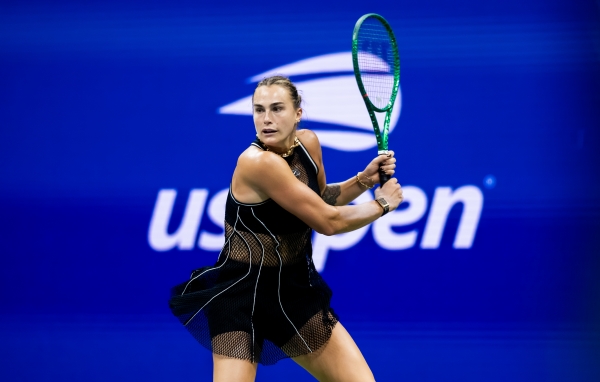
However that backhand variation manifests – whether it be change of direction in the men’s game, or change of spin and trajectory in the women’s – it’s clear that players are recognising the benefits.
The data reflects that Fritz has been hitting more backhands down the line in 2026 compared to the previous year. And anecdotally, we’re hearing more players are trying to follow suit.
David Law, co-host of the Tennis Podcast, revealed this came up in a conversation he’d had with Goran Ivansevic, current coach of Cincinnati Masters champion Arthur Fils.
"One of the things that Fils is really, really good at is going crosscourt [in] backhand exchanges,” Law said in an October episode. “[But his next opponent in Tokyo Valentin] Vacherot has a great backhand. So this is the moment whether we're going to find out whether the stuff that Goran's been working on with Fils – which is to go down the line on the backhand more – is he prepared to do it?
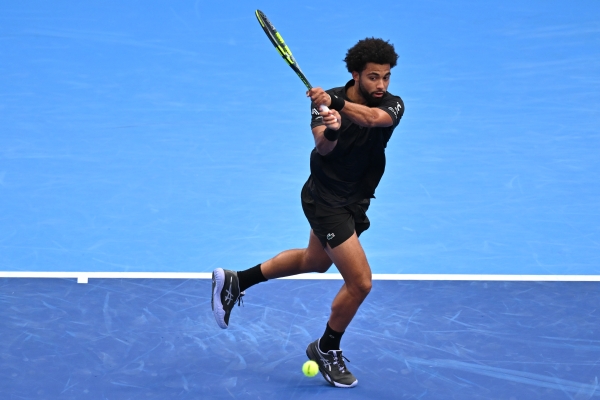
"Goran says it doesn't matter how good your backhand is, if people are leaning left, because they know that's coming [crosscourt], you've got to be able to pull the trigger the other way.
"So it's quite an interesting work in progress, to see Fils' development."
Vacherot ultimately overcame Fils in a closely-contested three-set battle, but it will indeed be fascinating to see how Fils works to add layers to his game to attain new heights.
And for fans, the fact players are committing to extra variety, taking more risks, surprising opponents with pattern changes and adding more weapons to their games can only benefit the viewing experience.