A dozen Grand Slams. That’s the current streak of majors won by a man named either Roger Federer, Novak Djokovic or Rafael Nadal, a group so dominant they’ve earned the 'Big Three' nickname.
But the Australian Open 2020 men’s semifinals are headlined by only two of the trio: Federer and Djokovic, after Nadal was stunned by Dominic Thiem who will face off against Alex Zverev for a place in a final now guaranteed to be a clash of the generations.
A potential changing of the guard has loomed in recent years despite an inconceivable consistency that has seen the Big Three represented in all but five Grand Slam singles finals since Wimbledon 2003, when Federer won his first major.
Although a male player born in 1990 or later is yet to reach the pinnacle of the sport by capturing a major, a handful are edging closer.
Austria’s Thiem took a set off Nadal at last year’s Roland Garros final, improving from a straight-sets loss in 2018. And Russia’s Daniil Medvedev pushed the Spaniard to five sets in an enthralling US Open final last September. In Melbourne on Sunday, either Thiem or Zverev will have another chance to break the gridlock.
Djokovic, 32, asserted that the likes of Thiem, Medvedev and Tsitsipas will soon break through in the tournaments that matter most, specifically the majors.
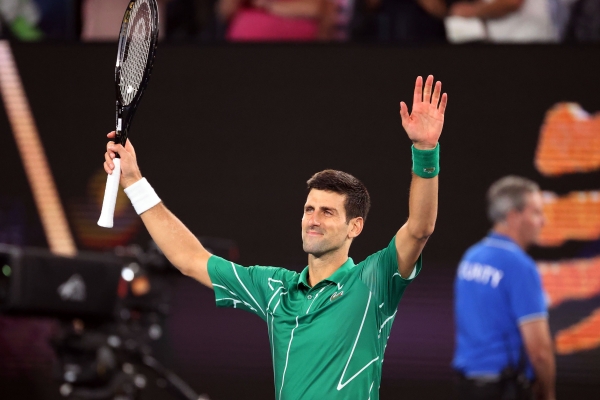
“It’s going to happen, it’s inevitable,” he said at the beginning of the fortnight.
“They're very close. I don't think that's miles, miles away maybe as it was some years ago. I think they are definitely hungry, they're challenging, they're knocking on the door.”
But while there may be a breakthrough in Melbourne, the 16-time Grand Slam winner isn’t certain that anyone will be able the immediately replicate the level of consistency the Big Three has achieved.
“I think [it takes] a player to gain that mental and emotional maturity and experience to understand his own strengths, to kind of fight his own fears, to really be able to maintain that level for a long time,” he said.
“Rafa, Roger, and I, obviously because of the past 10, 15 years, we know what we need to do mentally … that gives us probably a little bit of an edge.”
The overwhelming success of Djokovic, who holds a record seven Australian Open titles, and Federer, whose record eight Wimbledon titles and five consecutive US Open titles are part of an overall haul of 20 Grand Slams, has armed them with somewhat of a psychological advantage over the so-called next generation.
“I think we are still a pretty long way from overtaking [them] or from breaking this kind of barrier,” said fifth-seeded Thiem after upsetting Nadal in the quarterfinals.
“To really break a barrier, one young player has to win a slam,” said the 26-year-old.

His next rival, German seventh seed Zverev, is cautiously optimistic about dethroning one of the Big Three at the Australian Open.
“I did beat Stan just now, who is also a multiple Grand Slam champion, which gives me a little bit of confidence that I can do it,” said the 22 year-old after his quarterfinal defeat of Stan Wawrinka, the last man to deny the Big Three a major title by defeating Djokovic at the 2016 US Open.
But anything is possible, and two more wins in Melbourne will give Zverev newfound bragging rights as the youngest player to halt the Big Three’s dominance since Juan Martin del Potro who, then aged 20, shocked Federer to win the 2009 US Open. In doing so, the Argentinean snapped the trio’s winning streak of eighteen straight majors from Roland Garros 2005 through Wimbledon 2009.

Over a decade later, Djokovic is 32 and Federer is 38. Improbably, they aren’t slowing down.
“Roger has talked about this, Rafa as well, that age is just a number,” Djokovic said before the tournament.
“The three of us have inspired each other throughout our rivalries and careers to be better, to understand how we can overcome obstacles in the match-ups that we have against each other or anything else really that followed our careers.”
The Serbian, who is seeking to break his own record by winning an eighth Australian Open title, said he’s increasingly grateful that he’s been able to compete in the same era with Nadal and Federer, crediting those rivalries for developing him into the strong, resilient, motivated athlete he is today.
“I think [we’ve] found a way, a formula, to balance [our] private-professional life so we are able to kind of excel in tennis and still be able to compete at the highest level after many years, still be motivated, still be mentally fresh and, of course, physically prepared and fit to compete in best-of-five sets with young players that are coming up,” Djokovic said.
Come Sunday, motivation won’t be an issue for either finalist. Since Federer’s first of six Australian Open titles in 2004, two players outside the Big Three have had their names etched on the Norman Brookes Challenge Cup: Marat Safin in 2005 and Wawrinka in 2014. In 2020, it could finally be a next generation player’s time to shine.