Japanese prodigy Tokito Oda has made history, winning the Australian Open 2026 men’s wheelchair title over Martin De la Puente, 3-6 6-2 6-2, to become the youngest man to hold all four Grand Slam titles at the same time across any format of professional tennis.
At just 19 years of age, Oda’s triumph over the third seed at Melbourne Park also makes him only the second man to claim four consecutive men’s wheelchair singles majors, joining fellow Japanese legend Shingo Kunieda, who remarkably won 12 in a row from 2007.
The victory is Oda’s second AO crown and eighth major title overall, leaving him two shy of Britain's Alfie Hewett.
Now firmly established as the world No.1, Oda is already setting a pace that puts Kunieda’s record haul of 28 men’s wheelchair singles Grand Slam titles within sight.
“First, I gotta say, I was missing you, baby,” Oda jokingly said to the trophy he first won in 2024, before turning his attention to De la Puente.
“I want to appreciate Martin. You are my best friend on tour. We always hang out every time, and you speak Japanese, so sometimes it’s so funny with you,” Oda said.
“It’s the first time we shared a final at a Grand Slam. I was very happy to play with Martin. Big congrats to your team.”
Oda also won the doubles title, partnering Argentinian Gustavo Fernandez for his second Grand Slam doubles crown.
“Thank you all, I really appreciate all of your love … I hope you guys keep supporting wheelchair tennis. Thank you so much.”
The championship match began with De la Puente racing out to a 3-1 lead in the first set, before the first rain delay of the day. Although Oda briefly clawed his way back, the Spaniard struck again to hand the Japanese star his first lost set of the tournament.
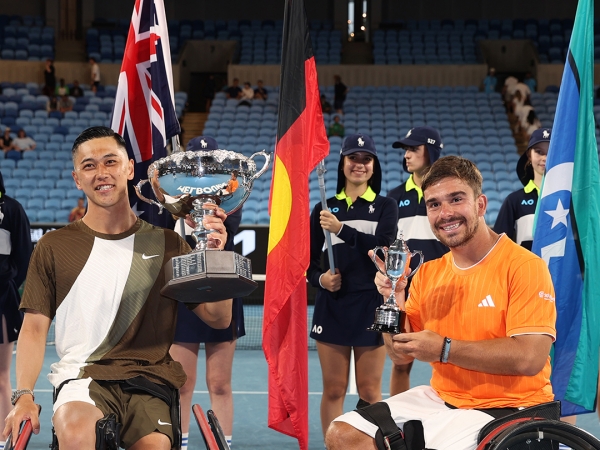
Oda lifted his level decisively in the second, tracking down balls with speed and driving his returns deep into the corners, using heavy spin to push De la Puente out of position.
Following a lengthy rain delay, Oda resumed control under the Margaret Court Arena roof and closed out the title, finishing with 52 winners to De la Puente’s 31 and winning 74 per cent of first-serve points compared to his opponent’s 51 per cent.
It marked the 18th meeting between the pair, their sixth at a Grand Slam, and the first time they had faced each other in a final.
De la Puente was bidding to become the 13th player to win a men’s wheelchair singles Grand Slam title, having previously lost in the Wimbledon final to Hewett in 2024. Despite the disappointment, the Spaniard was gracious in defeat, absorbing the moment with a smile.
“Congrats, Tokito, we’ve known since you were almost a kid, you already destroyed everyone’s chair on tour … you are a great champion,” he said.
“Thanks to my team. They’ve been pushing me a lot, I was struggling a lot at Christmas. It was a tough time for me, and they were pushing me — my team, my family, my girl — they were all pushing me.
“Hopefully, we’re gonna have another battle next year.”
In addition to Oda’s title victory at Melbourne Park in 2024, he also finished runner-up to Hewett in 2023 and 2025. He has now won 41 singles titles before turning 20.
Oda began using a wheelchair at the age of nine after being diagnosed with bone cancer in his leg. Originally a soccer player, he later transitioned to wheelchair tennis.
“Maybe from when I started tennis, I don't think about a Grand Slam title,” Oda said when asked about his biggest childhood dream.
“I was dreaming of the Paralympic Games, but it was different. I just want a battle since I was a kid. I just love the battle with somebody, you know.
“This is kind of like my dream to play the big match.”
While he looks up to Kunieda as a sporting benchmark, Oda’s first hero was Brazilian football great Neymar Jr, whose flair and individuality left a lasting impression on him.
“Because he changing hairstyle every match, so I just love his style. And he's still playing. I was doing the same hair as him.”
As the Australian Open celebrates 50 years of wheelchair tennis, Oda’s ascent to stardom stands as a powerful reflection on how far the sport has come — and a compelling sign of where it is headed next.