Like sleight of hand, the Australian Open’s transport system moves to and from Rod Laver Arena’s driveway in a discreet now-you-see-them, now-you-don’t fashion.
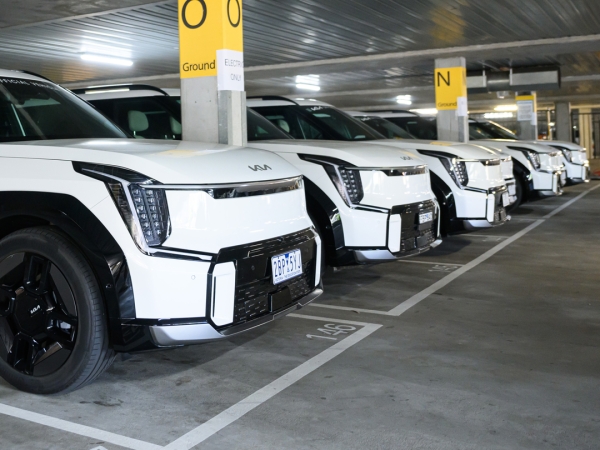
The underground driveway is in constant flux, the Kia EV’s whisper quiet as they roll to a stop outside the player entrance, depositing players ready to check in for the day. Among the 55 fully electric vehicles, buggies zip across the labyrinthine basement of Rod Laver Arena.

It’s organised chaos; to the untrained eye, it’s difficult to keep track of the comings and goings of all the vehicles. But to Transport Head Supervisor Neale Baker and Supervising Driver Sam Pasalidis, it’s business as usual.
Baker and Pasalidis have a combined experience of 91 years working in the transport sector of the Australian Open. Throughout that time, the AO has blossomed from a smaller-scale operation in the 1980s into the global phenomenon it is today.
“I started as a driver and now I'm the Head Supervisor,” Baker says. “I suppose [what’s changed is] the sheer size of the staff that we have to look after. So, we're up to over 400 staff, and back when we started there was probably 30, 20 people.”
“With 20 or 30 cars,” adds Pasalidis.
“I started as a driver at Kooyong in 1980," Pasalidis says. "And then after about 27 years, a position came up as a supervisor, and I was lucky enough to get it. So, I’ve been a supervisor the last four years, I've just been driving Novak [Djokovic], which is a bit of a role change.”
One might think driving a tennis great like Djokovic might be a daunting task, but Pasalidis remains unfazed.
“It's just like driving anyone. You just gotta drive carefully. Don't speed, you know? And it doesn't matter whether you're driving Novak or driving some other player. You just drive the same way.
“[Whether] it's Novak or it's Rafa [Nadal] or it's Roger [Federer] or someone like that … for me, it's just driving.”
Baker has a different take. “From a supervisor's point of view, it's a little bit more important because Novak is high profile, but also just the level of recognition that he gets [means] it's important for us… that [Sam’s] the one driver bringing him in.”
It’s not by chance that Sam has been Novak’s driver for the last several years.
“The fact they, Novak specifically, ask for Sam to come back each year and be his driver is obviously significant,” Baker says. “We don't just throw Sam in; Novak and his team request him.”
During the tournament, there is no daily rhythm for Pasalidis. He must be ready at a moment's notice to transport his passengers to where they need to be.
“I'm just at their beck and call,” he says. “I just wait for a text message [to know] what time to be there in the morning, and it just goes from there.
“I could be spending two or three hours just driving around, taking [Djokovic] to get a treatment, picking up some of his other team and bringing them back here or taking them back to the hotel. So, for me, it changes every day.”
Back at the Transport Office by the player lounge, Baker’s day has a little more structure. “I'd normally start between six and seven in the morning and probably go officially through to about four or five in the afternoon. But that could blow out to, you know, much later, depending on what happens.
“We've got a really fantastic team of people, so [I’m] really just [trying to] make sure that I can smooth things out for them, [so they can] run the day rather than me controlling it.”
The camaraderie between the transport team is clear to see. From friendly jokes lobbed across the driveway like tennis balls, to the communal stash of lollies behind the desk, this familiarity is one that only comes when a group of people spend years perfecting the rhythms of working together under pressure.
Aside from the seasoned team members who know their way around the tournament, the transport squad has seen a recent inflow of new staff largely due to the increased use of buggies.
“We're developing quite a great little crew because the use of the [buggies] has just blown up,” says Baker. “So, it's become a whole section of our transport system. We've got a couple of young girls driving in there. It's been great.”
Part of that new crew are Baker’s own daughters. “They toot as they go past,” Baker laughs. “Probably shouldn’t.
“They're really enjoying it and it's good to see how excited they are. [They’ll tell me], ‘oh, it's Sinner in the buggy’, and all of those sorts of things.”
Baker and Pasalidis may have a more blasé approach when it comes to the excitement and who’s who of the Australian Open, but after 45 years for Baker, and 46 years for Pasalidis, there must be something that keeps them coming back year after year.
For Baker, it’s that team camaraderie that makes the AO feel like home. “I think being part of this exciting event … [and] the individuals I work with – not so much the players – the team that I work with is what brings me back.”
“It’s just the people,” Pasalidis says. “And I just love doing it. I can't put it any simpler than that. It's just I really love coming here. Hopefully [it] can continue for another few years.
“I don't know when it's gonna stop, but yeah. I'll keep coming.”