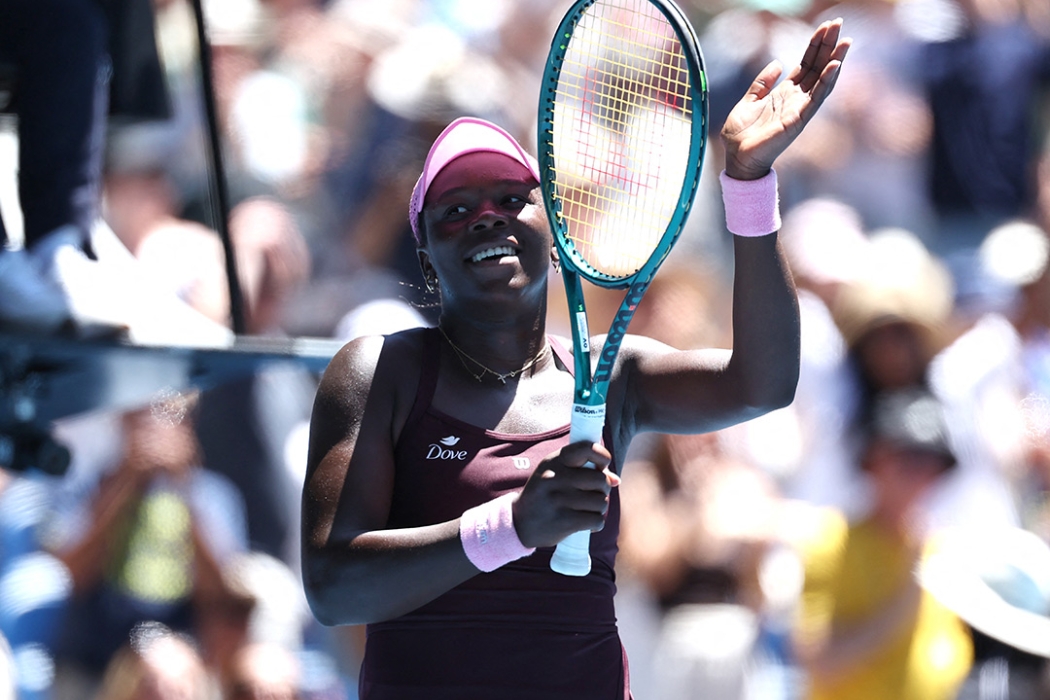
Maddison Inglis is beaming as the last local standing in the women’s singles draw at Australian Open 2026.
There is no need to ask the 28-year-old how she’s feeling having advanced to third round, as it’s written all over her face.
MORE: AO 2026 women's singles draw
Inglis earned her spot in the main draw through qualifying and is balancing singles with a mixed doubles campaign, playing alongside fiancé Jason Kubler. The latter she describes as “fun”, the former is an opportunity Inglis has not had since 2022, when she last played in the main draw of a Grand Slam.
“It’s crazy once you get out there, once you get playing. You want it so bad, it’s crazy what you can do. I’m so happy,” Inglis said after an emotional and gutsy triumph over German Laura Siegemund on Thursday.
Inglis will face four-time Grand Slam champion Naomi Osaka in the third round on Saturday, distinctly humble about how far she has come at AO 2026, but also determined to generate further momentum that could carry her to new heights throughout the season.
“I haven't been able to crack the top hundred yet. I had some really good results last year. But you do, you know, have those doubts naturally,” Inglis said.
“But seeing the tennis I've played this week, and the way I can kind of compose myself in those big moments is really cool. I'm really proud of that. I'll take it into the rest of the year.
“Tennis is so crazy sometimes. I just kind of kept fighting. Everyone around me said, ‘Keep believing and just back yourself.’ They really helped me get to this stage.”
Inglis, like many of the Australian players competing at AO 2026, has been buoyed by the enthusiasm of record home crowds. The colloquial chant ‘Aussie, Aussie, Aussie, Oi, Oi, Oi,’ becomes part of the collective vernacular whenever a local takes to the court.
That said, if you have seen Zeynep Sonmez play, you could be forgiven for thinking you’d been teleported to Turkiye. The emerging star scored a $328,000 payday advancing to the third round, but her impact at AO 2026, following a breakthrough at Wimbledon last year, extends beyond bottom lines.
Sonmez has become an inspiration to the Turkish community in Melbourne, who have arrived in throngs with flags in hand, and has also influenced how the game is perceived in her homeland.
“I’m the only player playing a Grand Slam right now from my country,” Sonmez said.
“I would say football is the biggest sport in Turkiye, and then maybe basketball, and then maybe after that tennis, but it’s getting bigger. I think after last year, Wimbledon, there were a lot of people who started to play tennis, who was watching the matches more, and now people are able to watch my matches too.
“It was difficult to watch the matches in Turkiye but now there’s more attention to tennis, so I think it’s going in a good way.”
Grand Slams can revive careers, launch careers and sustain them. No one contesting the Australian Open takes it for granted, not even 24-time Grand Slam champion Novak Djokovic.
The 38-year-old has claimed 10 Australian Open titles previously. He has nothing to prove here, and arguably nothing to learn, although he is always striving to.
MORE: AO 2026 men's singles draw
Asked what someone of his stature can gain from coaching staff, the Serbian provided an insight into the unseen challenges of competing at the highest level of the sport.
“I think you always need at least a pair of eyes on the side of the court, if not two pairs or three pairs, that know tennis and have different expertise, and they have different angles of seeing your game and your opponent’s game,” Djokovic said.
“I obviously know the game of tennis very well but very often, particularly in the competitive weeks, when you are under stress and emotions are not as at bay as they normally are in a non-competitive week, then you have to handle much more than just your tennis and how you hit your forehand.
“I feel like the coaching team is contributing not only to observation from the side of the court – how you move, how you play, the technical stuff, the biomechanical stuff – but also how you feel and helping you manage your emotions on a day-to-day basis.
“It’s more than just execution of the tennis shots, there’s more things that come into the equation because you’re an individual athlete, so there’s no substitutions, there’s nobody that can replace you if you’re having a bad day.
“Maybe you’re not necessarily feeling the best but you still have to find a way, and I think the coaching team, the physio team, the fitness team, is there to provide the necessary support for you to excel in your performance, and also find solutions during the match when you’re overwhelmed with what’s happening and sometimes can’t think clearly.
“That’s why you look to your team and ask for some guidance and observation that can be very helpful.”
You can gain a lot from the Australian Open and from Grand Slams. But you also must give a lot, too.