In a match that broke records, disrupted the schedule and lives on in history, Chanda Rubin’s 6-4 2-6 16-14 defeat of Arantxa Sanchez-Vicario in the Australian Open 1996 quarterfinals put the young American on the map.
What’s more, the two women at the centre of this three-hour, 33-minute epic joined forces in the following days to win the women’s doubles tournament.
Rubin’s win over Sanchez-Vicario – which you can now watch in full on the Australian Open YouTube channel – propelled her into her first Grand Slam semifinal, where she came within two points of stunning eventual champion Monica Seles.
It’s one of a growing number of full matches uploaded to YouTube from the archives as part of a comprehensive digitisation project.
“It was like this knock-down, drag-out match,” Rubin recalled on The Sit-Down podcast, almost 30 years on from the contest.
“We both were so competitive and wanted to win, but it was still just competition, and you could leave it on the court, you could compete in a way that was still doing honour to the sport, and then be able to come back the next day and play together.
"And so it was a lot of that wrapped up, in terms of my memories of that match, and the overall tournament. Like it was amazing how things just came together during that week.”
Rubin was just 19 at the time but had taken strides on tour the previous year when she notched her first major quarterfinal at Roland Garros and ended 1995 inside the top 15.
Rubin began 1996 with a quarterfinal at the Sydney International then travelled to Melbourne Park and embarked on another deep Grand Slam run. There she outplayed sixth seed Gabriela Sabatini to set up her quarterfinal showdown with Sanchez-Vicario, the world No.3.
Their match was a night-session quarterfinal at Rod Laver Arena, which preceded the men’s blockbuster between defending champion Andre Agassi and two-time AO winner Jim Courier.
As Rubin and Sanchez-Vicario battled beyond the three-hour mark and well into an extended third set, fans were torn – riveted by the classic unfolding while also desperate to see the most-hyped match of the tournament.
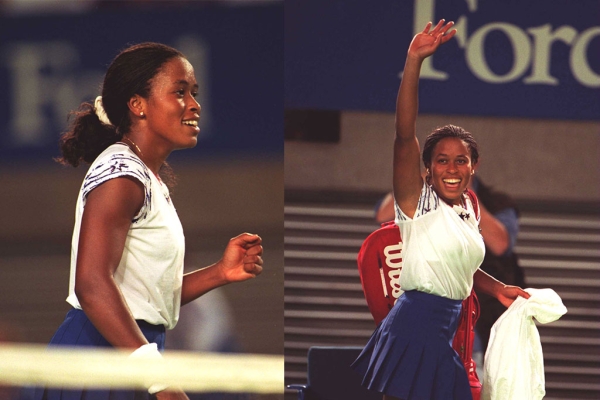
"That [projected Agassi v Courier match] actually got a lot more build-up once the tournament started and they both started winning … so they both made it to the quarterfinals, and we get this Agassi and Courier [match-up], oh my goodness, and these women are still playing!” Rubin laughed.
"I remember during the match, a few people screamed out, 'We want the men!' and I'm like 'I'm trying to get off the court too!' Nobody is trying to stay out there for three-and-a-half hours! And we all want to see Agassi and Courier as well.
“But you know, we're fighting for ourselves on top of it too.”
When Rubin finally sealed victory, it ended the longest women’s match in Australian Open history, both in duration and number of games played.
RELATED: The 10 longest matches in Australian Open history
While four AO women’s singles matches have since spanned more minutes, Rubin v Sanchez-Vicario to this day remains the longest in terms of games played, at 48 – equalled only by the bruising 2018 encounter between Simona Halep and Lauren Davis.
The ripple effects of Rubin’s win persisted.
Agassi and Courier finally began their match around 11pm and completed only nine games of their first set before rain fell. Back then, the Rod Laver Arena roof took much longer to close and the decision was made to suspend the match and resume it the next day.
The Americans returned to the same court less than 24 hours later, and Agassi eventually prevailed in five sets.
The following day, Rubin was back at Rod Laver Arena against Seles in her first, and only, Grand Slam semifinal.
Seles was the sentimental favourite; she was playing the Australian Open for the first time in three years in just the fourth tournament of her comeback after being stabbed on court during a match in April 1993. Yet Rubin, showing few effects of her sapping battle a round earlier, arrived on the brink of her third consecutive top-10 win when she built a 5-2 third-set lead.
Seles rebounded to triumph 6-7(2) 6-1 7-5 and then went on to win the final – the last Grand Slam title of her career.
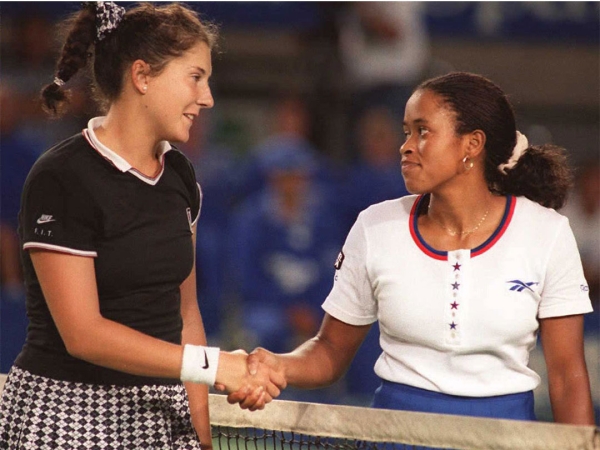
"Looking back at parts of my career, there's certain snippets that are bigger than anything else. And that Australian Open is, for a number of reasons,” said Rubin, who peaked at world No.6 later that year and ended a season inside the top 10 for the first time in 2003.
“I think about [that semifinal] with some positives. I mean, it's also kind of bittersweet because I was so close and I think just the moment got to me a little, and I didn't have a lot of other opportunities [to get that deep in a Slam]; various injuries, timing, that kind of thing.
“But it was an amazing experience. I was playing Monica, who I'd been watching on TV, and she was making her comeback. I still look at those kinds of matches as a privilege, win or lose.
“When I see Monica, usually at Indian Wells, we kind of have our little chat and there's a little connection there, because you go through a bit of a war against the other, and there's respect there.
“I think that's bigger and better than anything else.”
Listen to the full episode of The Sit-Down, a weekly podcast released each Monday featuring an in-depth interview with a notable tennis identity. Subscribe to The Sit-Down in your favourite podcast player.