Wheelchair tennis is many things to many people.
It’s a rare sport in which players with a disability can travel the globe and make a living. It’s exciting tennis for fans during the second week of a major. It helps people understand that a physical body doesn’t define ceilings in life. It’s also a reminder that nobody is alone.
Fifty years ago, Olympic skier Brad Parks sped down a mountain and fell on his back. Doctors said he would be paralysed from the waist down for life. As he came to terms with his diagnosis, Parks began shooting hoops in a wheelchair and then attempted to hit some tennis balls over the net with his father.
During a check-up at his rehabilitation centre, the Californian met Jeff Minnenbraker, a paraplegic recreational therapist whose customised chair intrigued him. Minnenbraker compared the wheelchair to a sports car, making the wheels as quick as possible and removing push handles for independence.
From there, Parks learned how to make his own wheelchair, and the seeds of hope were sown.

“I had the opportunity to start an organisation to develop the sport, organise tournaments, and give exhibitions and clinics to show and teach others to play,” Parks said.
“It caught on, and we all felt this was a very special sport, allowing people with disabilities to play with able-bodied friends.”
Today, wheelchair tennis is played in almost 100 countries, with a professional tour spanning 160 tournaments in 41 nations and a total prize purse of $1.5 million.
In 1992, it became an official medal sport at the Summer Paralympics and has been featured at all four Grand Slams since 2007.
For Australian David Hall, whose career includes nine Australian Open titles, eight US Open titles, a Paralympic gold, a former world No.1 ranking, and Hall of Fame induction, wheelchair tennis gave him purpose after a car accident left him without legs.
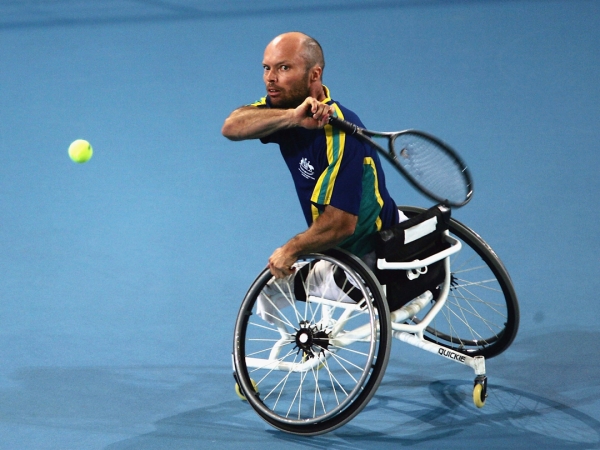
Not only did the sport present opportunities, but it also helped Hall shift the perspective of his own life from a victim to a competitor.
“When life hits you in the face or puts you through the blender, sometimes you have to bear your fangs to get out of it. You got to toughen up,” he reflected on The Sit-down podcast.
“Whatever negative energy I had, I could pour into hitting tennis balls. The negativity and anger and confusion, and ‘Why me?’ just got left in the past. I woke up one day, and I felt really good.”
Hall was a finalist in the inaugural Australian Open wheelchair men’s singles event in 2002, the first Grand Slam to stage the discipline. He claimed the title in 2003 and reached the final again in 2004, the year in which wheelchair doubles made its debut.
Since then, Melbourne Park’s Centre Court has crowned champions from 11 nations.
The era has been defined by two giants: Japan’s Shingo Kunieda, an 11-time singles and eight-time doubles champion, and the Netherlands’ Esther Vergeer, who collected nine singles and eight doubles titles. Paralysed by vascular myelopathy as a child, Vergeer held the world No.1 ranking from 1999 until her 2013 retirement, finishing her career on a 470-match winning streak – a dominance rarely seen in any sport.
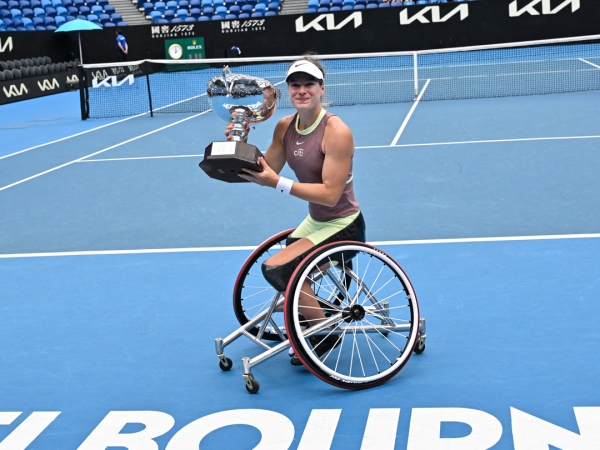
Fellow Dutchwoman Diede de Groot has since taken up the mantle, winning a total of 23 Grand Slam wheelchair singles titles — the most by a female player.
Former world No.1 Dylan Alcott made the most of his opportunities too, from a child born with a tumour wrapped around his spinal cord to become a universally beloved Australian of the Year.
“Winning gold medals and Grand Slams isn’t my purpose,” Alcott said in his acceptance speech.
“My purpose is changing perceptions so people with disabilities like me can get out there and live the lives they deserve to live.”
After 23 major titles, Alcott has become a leading television host, podcaster and presenter, continuing to use his platform to champion inclusion. As his cultural influence grows, so does the sport.
Australia’s role in wheelchair tennis moves into an exciting new chapter on its 50th anniversary, with three new international events in Brisbane, Sydney and Adelaide making the 2026 Australian Wheelchair Tennis Summer Series bigger than ever.
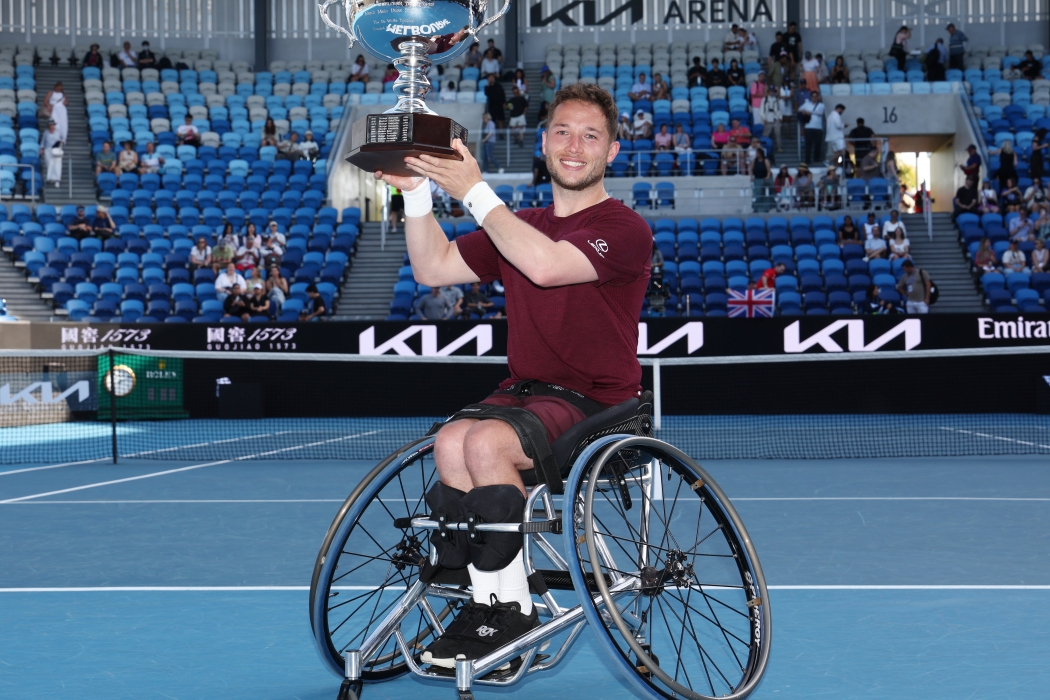
Men’s world No.2 Britain's Alfie Hewett sees the expansion as a milestone.
“It helps make the sport more visible, brings new eyes and a new audience, and potentially new players,” the defending champion said.
Hewett will compete for his third Australian Open title in 2026.
With each new tournament and every crowned champion, the sport Brad Parks pioneered continues to inspire and redefine possibility.